Experience NexUS!
“Enlightened trial and error succeeds over the planning of the lone genius.” — IDEO
NexUS develops future entrepreneurs.
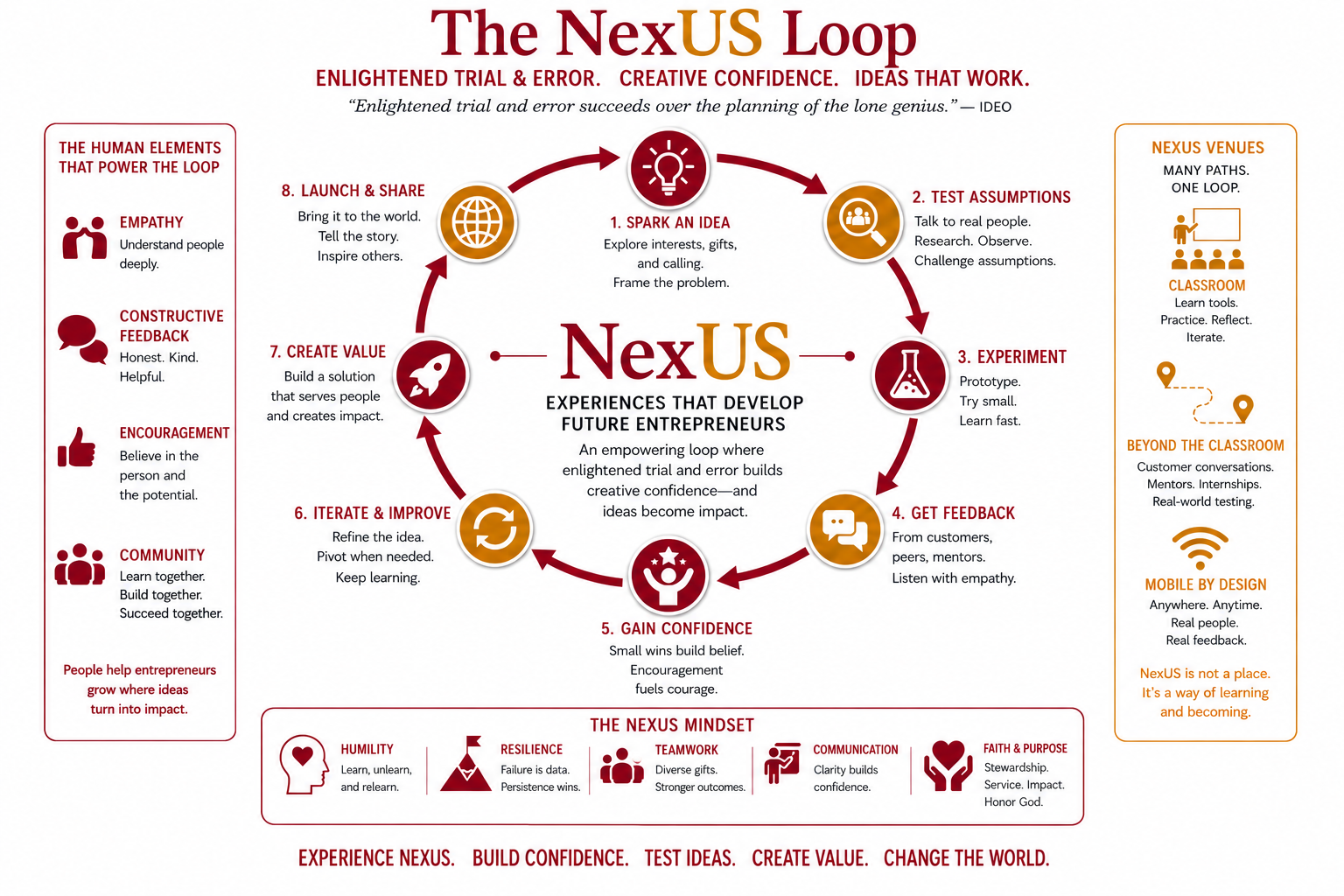
Future entrepreneurs emerge through experiences that test their ideas, gifts, and calling. Thus, AI and the internet alone will not suffice. Entrepreneurs need the human elements of empathy, constructive feedback, and encouragement to engage in the empowering loop of creative confidence and enlightened trial and error, which launched entrepeneurs and their ideas. How do I know this? From working with and studying entrepreneurs.
Since 1989 I have been a college professor. Since 2010 I have worked with students exploring if entrepreneurship is a vocational answer to their calling and teaching them ways to test their business ideas. And, over the course of my teaching career, in fits and starts, I have studied and written about entrepreneurs.
Here’s what I’ve learned: entrepreneurs grow in empathetic communities that provide expertise and the encouragement to experiment. Kelley and Kelley (Creative Confidence) are correct: the more entrepreneurs engage in enlightened trial and error, the more their creative confidence grows, which increases their practice of enlightened trial and error. This empowering loop enhances their ability to bring ideas to life.
NexUS is the name we give to those experiences that facilitate the empowering loop of creative confidence and enlightened trial and error. They help us develop entrepreneurs and business models that work.
One venue for NexUS experiences is the classroom. Below is summary of the wisdom of my Calvin University students from the Spring of 2026:
The experience goes beyond teaching business mechanics to developing wisdom, adaptability, and purpose-driven entrepreneurship. Students learn that entrepreneurship is not just about having a good idea, but about testing assumptions, learning from feedback, and refining ideas through real-world interaction. Tools like the Lean Canvas, customer interviews, prototypes, and pitch presentations help transform ideas into viable business models while reducing risk.
A central lesson is the importance of humility and adaptability. The sequence of learning is “learn, unlearn, and relearn,” recognizing that initial assumptions are often wrong and must be challenged. Feedback from customers, peers, and mentors becomes essential, shifting the focus from personal ideas to real user needs.
Another key theme is execution over ideation. While ideas are common, success depends on disciplined action—testing, iterating, and improving. Failure is reframed as a necessary and valuable part of the process, building resilience and leading to stronger solutions.
Also important in the learning process are communication, teamwork, and self-awareness. Frequent presentations improve confidence and clarity, while collaboration introduces diverse perspectives that strengthen outcomes.
Finally, the experience integrates a strong faith-based perspective, defining wisdom as applying knowledge with humility, stewardship, and a focus on serving others. Entrepreneurship is framed not just as profit-seeking, but as “redemptive”—creating value that benefits communities and honors God.
Overall, the experience equips students with practical tools, a resilient mindset, and a deeper understanding of how to build meaningful, impactful ventures.
And our NexUS classroom is mobile.